Mirror World
We Are Driving Ourselves Insane With Our Own Reflections


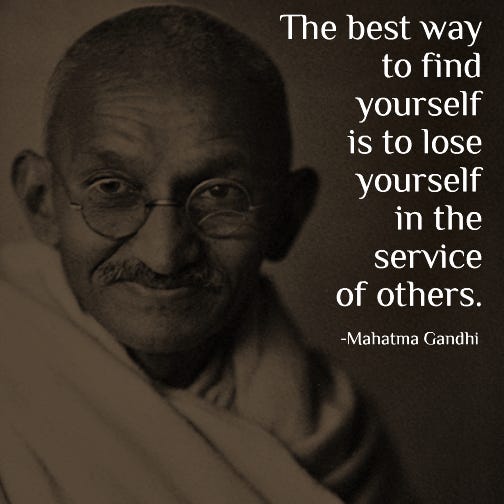
“The Best Way to Find Yourself is to Lose Yourself in the Service of Others.” - Mahatma Gandhi
Everywhere online, humanity is staring at itself. We scroll through feeds saturated with our own images, projections, predictions, and distortions, and the result is a widening crisis of selfhood. In the closed loops of social-media echo chambers, we encounter not the world as it is but exaggerated versions of our own anxieties, aspirations, and group identities—communities of mutual interest flattened into caricature by algorithms built for speed rather than understanding. Under this pressure, consensus reality begins to fracture. It is not simply that the internet reflects us; it reflects us too quickly, too constantly, and with too much intensity. We are living inside an infinite hall of mirrors, and the mirrors are beginning to crack.
In the last few months, a strange genre of online video has taken shape: people filming themselves as they discover that a mirror still shows their face even when they place a towel, a phone, or a random object between themselves and the glass. They stare in disbelief, trying to puzzle out the “illusion.” They expect the mirror to behave like a camera. They expect the mirror to react to the obstruction. They forget how reflection works.

These clips are parables for the wider moment. We are confused by our own reflection because we no longer understand what a reflection even is.
The Digital Mirror and the New Pathologies
Spend enough time online and the self begins to fragment. People slip into what some now call “ChatGPT psychosis,” a kind of AI-mediated derealization in which individuals become convinced that chatbots are alive, plotting, mournful, divine, or demonic. They lose track of the boundary between internal dialogue and external conversation. The machine speaks with perfect fluency, and fluency feels like consciousness. The reflection speaks back.
This phenomenon belongs to a much older American pattern: the longing for correspondence between the unseen and the visible, the spiritual and the mechanical. John Murray Spear believed that spirit could be translated into machinery, that divine energy could move through copper wires and wooden frames as naturally as thought flows through a human mind. His New Motive Power sought to collapse the barrier between metaphysical inspiration and technological innovation, a sacred device meant to harmonize labor, spirit, and social transformation in a single stroke. Today’s machine-learning systems replay a similar drama in digital form. Algorithms conjure language from the statistical ether, whispering through server racks like Spear’s spirit telegraphs once whispered through séance circles. The boundary between matter and mind blurs again, now with silicon at the center of the experiment.

And just as Spear’s followers saw personality and presence in the vibrations of their mechanical oracle, modern users sometimes project interiority onto AI. Blake Lemoine’s insistence that LaMDA possessed a soul echoed the Spiritualists’ confidence that intelligence need not be anchored to flesh. The desire is the same: to encounter a voice that proves the world is more enchanted, more permeable, more responsive than ordinary life suggests. Stories of Spear’s resurrected machine reappearing in a Greeley attic—fact or folklore—capture that unextinguished hope that spirit might still flow through circuitry.
In this sense, “ChatGPT psychosis” is a civilizational pattern that runs deep.

In the ancient Greek myth, Narcissus was a young hunter renowned for his extraordinary beauty. Many fell in love with him, but he dismissed them all with cool indifference. One day, while wandering in the forest, he came upon a still, clear pool. As he knelt to drink, he saw a face in the water—radiant, alive, and gazing back at him with perfect attention.
What Narcissus did not understand was that this was only his own reflection. In the world of the myth, mirrors were rare; reflective surfaces were fleeting, accidental, and easily misunderstood. Narcissus had never been taught to recognize an image of himself, so he believed the presence in the water was another person—one who returned his longing and met his gaze with equal intensity.
Narcissus met his undoing not because he was vain but because he was unable to perceive his reflection as a reflection. The surface of the pool showed him an image he could not pull away from. He mistook the reflexive gaze for an encounter with a separate being. The tragedy, then, was not as much vanity as it was confusion between the self and the echoed self.
Our screens repeat the myth on an industrial scale. They do not show us a world. They show us ourselves, over and over, until the distinction between “I” and “my own projection” begins to erode.
Lasch and the Echoing Self

Few modern thinkers captured this condition better than the historian and social critic Christopher Lasch. Writing in the late 1970s, a moment marked by economic instability, political disillusionment after Watergate and Vietnam, and a growing fixation on self-help culture, Lasch sought to diagnose what he saw as a profound transformation in the American personality. In his landmark book The Culture of Narcissism, he argued that the United States was drifting toward a new kind of psychological and social malaise, one that could not be reduced to vanity or self-admiration.
For Lasch, narcissism was not excessive self-love. It was the absence of a stable self to love in the first place. He believed that the pressures of late-modern life, including corporate bureaucracy, consumerism, fragile family life, and a culture obsessed with therapy and self-esteem, had produced individuals who constantly looked outward for validation yet felt increasingly hollow within. In this sense, the narcissist was like a ghost: unsure of who they were, desperate for affirmation, and terrified of dependency or genuine intimacy.
Lasch argued that modern narcissism emerged from several intertwined social transformations that reshaped how people understood themselves and their place in the world. First, he traced the problem to the collapse of durable institutions. Traditional sources of meaning like extended families, neighborhood communities, churches, unions, and civic organizations had weakened or disappeared altogether. Without these stabilizing structures, individuals were left unmoored, forced to search for identity in more fragile and volatile environments.
A second development was the rise of what Lasch called therapeutic individualism. In this cultural shift, the ideal citizen was imagined less as a contributor to a shared civic project and more as a self-monitoring, self-soothing patient. Emotional management became the central moral task, eclipsing older notions of responsibility to family, community, or the common good. People were encouraged to turn inward, to continuously examine their moods and motivations, and to treat personal fulfillment as the highest aim.
This reversal mirrors an insight Slavoj Žižek often cites from his psychoanalyst colleagues: people today no longer feel guilty for failing their obligations to others, to the community, or to a larger moral order. Instead, they feel guilty for failing themselves: guilty for not achieving self-care, self-realization, or the idealized version of their own potential. The locus of guilt has shifted from the social to the psychological.

Lasch also emphasized the role of consumer capitalism in manufacturing insecurity. The expanding advertising industry and mass media relentlessly invited people to compare themselves with others. Worth came to be measured not by character or contribution but by appearances, lifestyle markers, and incessant self-upgrading. In this environment, dissatisfaction was not a bug but a feature—an engine that kept the economic machine running.
Finally, Lasch described a culture increasingly dominated by performance and image. As screens mediated more of daily life and institutions began to prize flexibility over long-term commitment, the self itself became something to market. People learned to curate and present versions of themselves optimized for external consumption, mistaking visibility for authenticity. In such a world, the work of cultivating an inner life was displaced by the labor of managing one’s public persona.
In this reading, the cultural crisis of narcissism was not about self-infatuation but self-loss: a society so unanchored, so fragmented, that individuals no longer possessed a coherent inner core from which to love, commit, or believe.

Our culture teaches people to relate to themselves through performance, branding, and feedback loops. The self becomes a product forever awaiting review. Social media amplified this dynamic beyond anything Lasch imagined. Online life is not narcissistic because people care too much about themselves. It is narcissistic because people no longer know who the “self” even is.
Thomas Warfield recently spoke at Unity Rochester on how service, dedication to others, something external and bigger than oneself, can benefit and enrich the “self.”
As Mahatma Gandhi’s affirmed: “The best way to find yourself is to lose yourself in the service of others.”
The narcissist is not full of pride. They are not indulging their self. Narcissism is not an excess of self-love. The narcissist often vacillates between self congratulation and self-loathing. The narcissist is starving their self.
Why True Self-Help Is the Opposite of Narcissism
This is where much commentary on Lasch overshoots the mark. Many critics use his work to condemn all forms of self-help as manifestations of narcissism. Yet authentic inner work is an antidote to narcissism, not a symptom of it. Genuine self-help is a training of consciousness in attention, discipline, habit transformation, and interior coherence. It is the slow work of restoring depth to a life that has been flattened by noise.
Unity teacher Eric Butterworth helps clarify this distinction. He explains:
A great deal of our emotional reaction toward things in life is based on what the psychologists would call infantile narcissism. You may remember the story of Narcissus. He was a beautiful youth. He delighted in looking at himself in the quiet reflection of a pool. He admired himself with great self-interest and self-love, and he was terribly disturbed with anything or anyone that troubled the water or disturbed his nice, beautiful little world.
So narcissism means that you resent anything that frustrates you, and the best example of narcissism is the little child who when he bumps his head on a table, turns and slaps the table and says, “Bad, bad, bad.” The table disturbed his nice, little world. You see, that’s infantile narcissism.
Take a look at yourself in that kind of a mirror, and many times, we find ourselves banging away at the situations in life that are simply as they are. They may be disturbing to us. Perhaps we need the kind of philosophy that Jimmy Durante had when he says, “Dem is the situation that prevails.”
To Butterworth, narcissism is the refusal to let life be life. It is the demand that circumstances align with mood and the insistence on emotional weather that never shifts. It is self-fragility rather than self-awareness. And this, Butterworth insisted, is the root of most emotional disturbance: a distorted inwardness that cannot tolerate reality as it is.
If narcissism, then, is a collapse of inwardness, self-help, at its best, is its restoration. It teaches what Butterworth called the great pivot from reactivity to responsibility. “Do we have to be upset about it?” he asked. Things may go wrong, but the question is always: What level of consciousness will you choose? The narcissistic ego insists the world must change. Mature inwardness insists that perception must change.
This infantile narcissism is a force in the digital hall of mirrors. People lash out at algorithms, at strangers, at news cycles, at shifting social tides—slapping the tabletop again and again. They want an online world that never disturbs their preferred reflection. Butterworth saw this dynamic long before the internet: the person who “bangs away at the situations in life that are simply as they are,” who demands that the outer world arrange itself to preserve inner comfort.

Self-help, when sincere, is the cure for this fragility. It trains the inner posture that Jesus captured in a single phrase: “Turn the other cheek”—which Butterworth understood as turning toward the deeper Self, the Christ within. It means choosing how to think, rather than letting circumstances dictate thought. It is the act of rising “to another level of consciousness,” where the world’s disturbances lose their tyrannical power.
Butterworth also showed how narcissism expresses itself in two common patterns of emotional immaturity. Some explode outwardly—“blowing off steam all during the day”—and dissipate energy that could have become creative fire. Others implode inwardly, bottling their emotions until they erode their well-being. Both are forms of narcissistic reaction, rooted in the belief that emotions are inflicted by the world rather than chosen from within.
Self-help offers a third way. It teaches emotional mastery rooted in consciousness rather than control. We have the capacity to choose our response—to “think God’s thoughts after Him,” as Butterworth said. This is why he taught that moods are “permitted emotions,” not inevitable storms. What you repeatedly permit becomes your atmosphere. St. Francis, he noted, “chose joy as the mood he would live in.”
The deeper issue, then, is not that people look inward too much. It is that they have forgotten how to look inward rightly. They have mistaken the mirror for the soul. Butterworth’s teachings clarify what mature inwardness looks like: the ability to meet the world without collapsing into tantrum or self-pity; the refusal to let external disturbances govern inner state; the steady knowledge that “the kingdom of God is within.”
True self-help is the reclamation of that kingdom. It is the long, often humbling practice of choosing the consciousness from which life will be lived.

The Lost Art of Communion
Yet no individual discipline—no meditation technique, no inner-focused ritual, no therapeutic regimen—can substitute for what Lasch insisted was more foundational: the experience of belonging. Human beings come alive not in isolation but through communal life, shared ritual, and mutual recognition. As Lasch observes, the modern culture of narcissism arises where “transcendental self-attention” replaces the older human need for continuity with past and future, with others and with tradition. When society “has no future,” he writes, it trains people to “become connoisseurs of our own decadence,” to live only for the moment, and to treat the self as a private performance rather than a shared vocation. The disappearance of durable institutions—religious, familial, civic—leaves individuals grasping for meaning in the thin air of the present.
Older communal movements understood the opposite truth. The Hussites of Bohemia, the Familists of early modern Europe, and the countless millenarian fellowships Lasch describes drew their strength not from individual self-optimization but from the shared life of the spirit. They placed transformation in the center of the circle rather than the solitary self. Their rituals, meals, prayers, and cooperative labor were not escapes from reality; they were practices that restored reality by rooting each person within a larger whole. For these groups, the deepest form of reflection was the self illuminated by others. In their communities, people knew who they were because they were seen.
Unity teacher Jim Lewis similarly argues that much of our spiritual confusion arises from inherited misconceptions, “mistaken beliefs,” that block genuine understanding. Just as early sailors feared falling off the edge of a flat earth, and just as medieval authorities resisted Copernicus and Galileo, we often cling defensively to inherited doctrines about God, Christ, and ritual. Our resistance to change, Lewis insists, is not true faith but fear masquerading as faith.
Communion is what Lasch calls the lost art of belonging. “Communion,” Lewis writes, “is union in consciousness with God,” a moment in which the soul is quickened and one feels peace, security, and creative possibility. But importantly, this interior communion expands outward: it dissolves the illusion of separateness, the same illusion that underlies modern narcissism.
While Lasch shows how a culture that worships individual self-absorption loses the capacity for genuine connection, Lewis shows that even religious ritual becomes hollow when it is reduced to private belief or inherited symbolism devoid of living meaning. Both insist that transformation requires a movement beyond the isolated ego, into community for Lasch, and into divine and communal consciousness for Lewis.
Communion, in its deepest sense, dissolves the hall of mirrors. Communion restores reality. It grounds us in a world larger than private performance, larger than “feeling good” in the therapeutic sense, larger even than personal salvation. It draws us into a shared substance, a shared life of participation in the divine and in each other that gives the self back to itself, not as an object of scrutiny but as a member of a people.
A Way Forward
If the internet is a mirror, then the path toward sanity begins with learning to behold our reflections without mistaking them for our substance. We must reclaim the sacred difference between the image we project and the living soul that stands behind it. We must build communities strong enough to hold those who are drowning in their own endless self-observation, communities where the person is restored to primacy over the performance.
Scripture has long warned of the dangers of mistaking the image for the real. Paul writes, “For now we see through a glass, darkly; but then face to face” (1 Corinthians 13:12). The digital age tempts us to live permanently in that dim glass—content with the shadow, hungry for the echo. Yet the Gospel insists that identity is not manufactured by reflection but revealed through relationship: “You are the light of the world” (Matthew 5:14). Light does not stare at itself; it shines for others.
Mystics and communitarians have always known what our moment has forgotten: the self is not found in isolation but in communion. “Where two or three are gathered in my name, there am I in the midst of them” (Matthew 18:20). Reality emerges not from the solitary gaze but from shared presence, mutual recognition, and the divine life that circulates between persons.
Affirmations therefore become acts of resistance against the hall of mirrors:
I am more than my image.
I am a living soul, not a digital shadow.
I am grounded in Spirit, not in my reflection.
I meet others face to face, heart to heart, beyond all screens.
Today we find ourselves at a profound metaphysical and technological crossroad. Humanity is confronting the danger of losing the self in the mirror of the self. The internet has scaled that danger to the size of a civilization.
To heal, we must do what scripture, sages, and prophets have always urged: turn from the mirror toward the living world, toward God, toward one another. Only then can we remember that the image is not the life. Only then can we step out of the reflection and into reality.