“Sell your possessions and give to the poor.”—Luke 12:33
Thanks for reading! Subscribe for free to receive new posts and support my work.
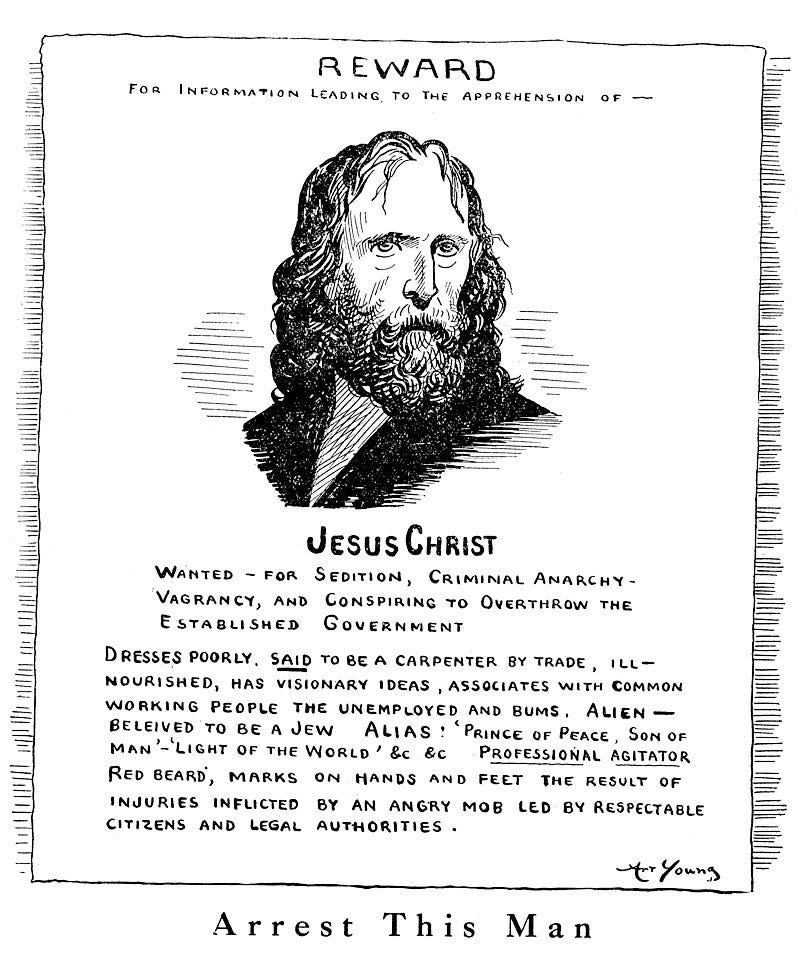
Jesus was not a capitalist. He was not concerned with preserving private property, defending free markets, or maximizing personal profit. He was a spiritual revolutionary whose ministry proclaimed a new economic order rooted in divine abundance, justice, and collective well-being. The Kingdom of God, as he taught it, was not a distant heaven but a new society coming into being on earth. “Do not store up for yourselves treasures on earth... but store up treasures in heaven” (Matthew 6:19–20). “It is easier for a camel to go through the eye of a needle than for someone who is rich to enter the kingdom of God” (Mark 10:25). These teachings point not only to generosity, but to redistribution, a radical reordering of life in which wealth and power are placed at the service of love.
Jesus’ Gospel was not abstract spirituality. It was social, even political, in its implications. As Edna L. Carter wrote in Unity Magazine (1916), “From the study of the work of race redemption as Jesus taught it... we must conclude that Christianity means a new governmental and social order based on Love and Justice.” For Carter, the Second Coming is not an escape from earth but the full revelation of Christ within society itself: “He has been with his people always as he promised, but in these last days there is to be a perfect revelation of his Presence and Power... a new civilization... born of the Spirit.” The Kingdom of God descends into the world through a civilization grounded in justice, compassion, and mutual care. “Whatever you did for one of the least of these... you did for me” (Matthew 25:40).
The early Christians took this message seriously. The Book of Acts records that “all the believers were together and had everything in common. They sold property and possessions to give to anyone who had need” (Acts 2:44–45). “No one claimed that any of their possessions was their own, but they shared everything they had” (Acts 4:32). This was the deliberate creation of a new economic system in which life was shared, needs were met, and accumulation was rejected. Each gave according to their ability, and the gifts were distributed to all according to their need. In this way, the first church embodied what might be called spiritual socialism.
This social vision places Jesus in the tradition of the Hebrew prophets, who thundered against economic injustice. “Woe to those who make unjust laws... to deprive the poor of their rights” (Isaiah 10:1–2). In this biblical stream, greed, hoarding, and exploitation are not merely economic failings but spiritual sins—acts that block the circulation of divine life.
The great prophets of metaphysical Christianity continued this witness. Charles Fillmore, co-founder of Unity, acknowledged in The Twelve Powers of Man (1918) that “Socialism has a truth back of it. The early disciples had all things in common... everything really belongs to the whole creation.” While not identifying as a socialist, Fillmore taught that metaphysical truth requires just economics. “We are all sharers in all things... the great Law will bring to us our very own... if we go about it in the right way” (Prosperity). For Fillmore, abundance was never meant for selfish accumulation. The power of the I AM should not be used to manifest wealth for ego gratification, but to align with divine order, peace, and justice. “If we unify our ideas with Divine Order, a mighty mind force will begin to work for us” (Christian Healing).
Wallace Wattles, writing under the banner of Christian Socialism, declared in his 1905 lecture Jesus: The Man and His Work that “the identity between the ethics of real Christianity and Socialism is perfect.” He rejected the sentimental, submissive Christ of church tradition, insisting instead that Jesus “was not humble in the accepted sense... He spoke as one having authority... and He cast out the money-changers.” Wattles says that the greatest riches are not achieved by greed: “You must lay aside your greed; have no unworthy motive in your desire to become rich and powerful. It is legitimate and right to desire riches, if you want them for the sake of your soul, but not if you desire them for the lists of the flesh.” Wattles saw in Christ the supreme organizer of divine justice: “Jesus did not come to bring peace, but a sword.”
Ralph Waldo Trine, in In Tune with the Infinite (1897), expressed this same truth in the language of universal law. “The law of love is the law of life. He who loves is in harmony with the forces that build, conserve, and redeem... he who refuses to love shuts himself from the very currents of abundance.” For Trine, wealth is meant to circulate; it withers when withheld. “It is the law of life that what we share multiplies, and what we withhold withers.” In this framework, greed is not only socially destructive but metaphysically self-defeating, cutting the soul off from divine flow.
George D. Herron, Congregationalist minister and Christian Socialist, preached that “The Kingdom of God is a social order. It is not a matter of saving souls out of the world, but of saving the world itself.” In Between Caesar and Jesus (1899), he warned, “The church must decide whether it will follow Christ and lose the world, or follow the world and lose Christ.” For Herron, capitalism was Caesar’s empire, and the church’s calling was to embody the cooperative commonwealth of Christ.
Adin Ballou, abolitionist and founder of the Hopedale Community, echoed this conviction in Practical Christian Socialism (1854): “The Kingdom of Heaven is to be realized on earth by the establishment of a divine order of society, wherein selfishness shall be subordinated to love, and all shall labor for the common good.” For Ballou, Jesus’ command to sell possessions and give to the poor was not symbolic but practical. “Christianity does not sanctify inequality; it abolishes it. Its spirit and law is: ‘All things common.’”
John Humphrey Noyes, founder of the Oneida Community, insisted in Bible Communism (1848) that “the community of goods practiced by the primitive church was not a temporary expedient, but the very law of heaven applied to earth.” For Noyes, divine perfection could not remain private or inward; it had to be social. “The Kingdom of Heaven is a social state... God is not the author of separate, selfish households, but of one family in Christ.” However controversial some of his other teachings may be, Noyes captured the heart of Acts: that the church reveals itself in shared life.
All of these voices point to the same conclusion: the Kingdom of God is not a fantasy, but the Divine Order breaking into human systems. The upheavals of history are the bubbling up of the contractions of spiritual labor, as Carter described, a race travailing until the new civilization is born. Christianity was never meant to sanctify capitalism. It was meant to supersede it with the economy of heaven—on earth as it is in heaven. “Seek ye first the kingdom of God, and his righteousness; and all these things shall be added unto you” (Matthew 6:33).
Subscribe to Christian Metaphysics with MKJ to explore the inner dimensions of justice, Spirit, and the coming divine economy.
Thanks for reading! Subscribe for free to receive new posts and support my work.